Interview with Alex Hill

Ahead of the final UK performance of at the this summer, I caught up with writer and performer to discuss the extraordinary journey of the show — from a 50-seat Edinburgh Fringe venue to the West End and Off-Broadway.
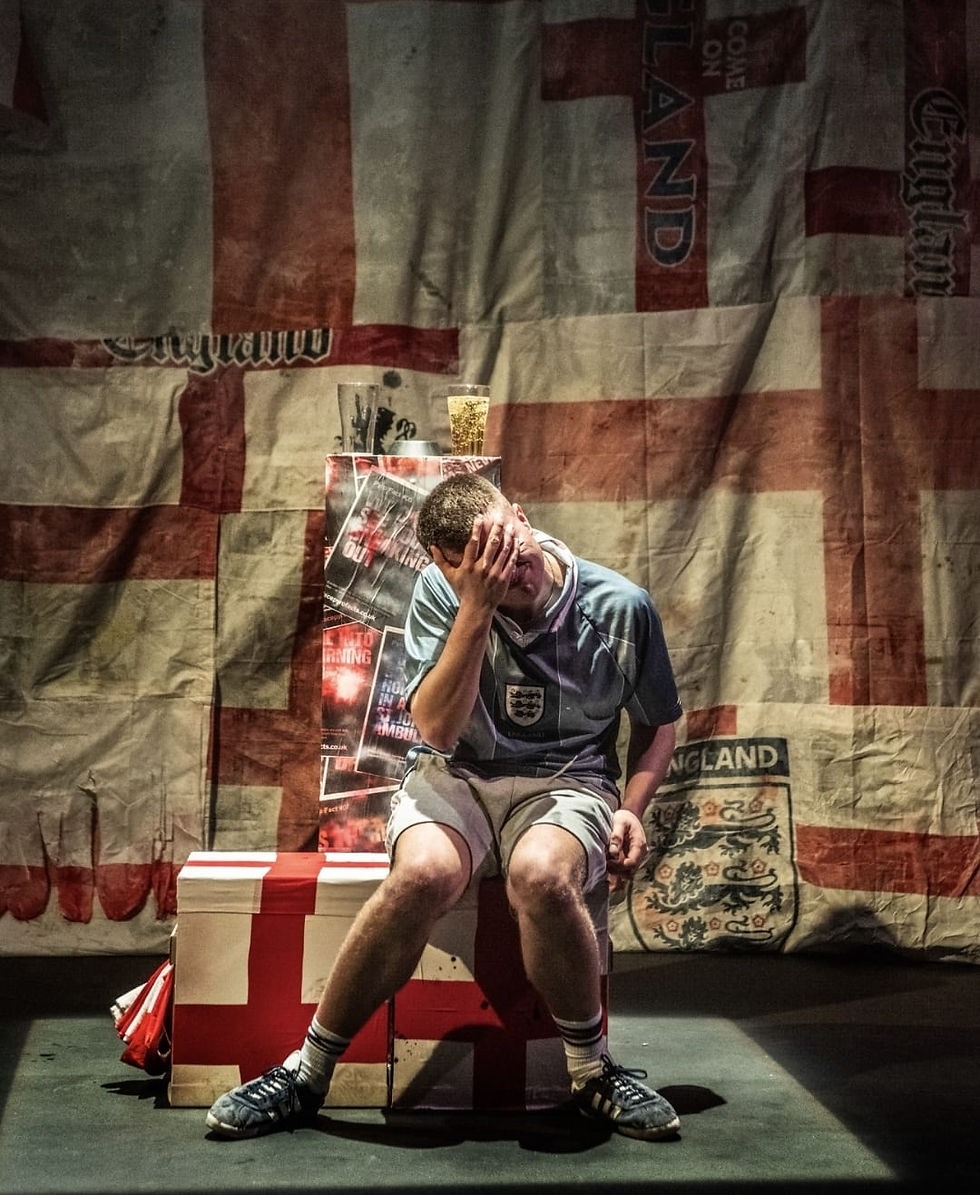
Inspired by one of English football’s most infamous viral moments, the critically acclaimed one-man play explores tribalism, toxic masculinity, male friendship, and the desperate search for belonging through humour, heartbreak, and football culture. As the show prepares to “set off one final flare,” I spoke with Alex about the emotional response to the production, performing such an intense solo role night after night, and why the themes of the play continue to resonate so strongly with audiences today.

When you first started developing Why I Stuck a Flare Up My Ar*e for England, did you ever imagine it would end up in the West End and Off-Broadway?
Nope. I would have laughed if someone told me that.
The title instantly grabs attention, but the play tackles some very serious themes beneath the humour. How important was that balance for you as a writer and performer?
I’ve always said that the title can be the play's best friend and worst enemy. Because it is so loud - I sometimes feel that people get put off coming to see it. But as you say, the play does explore themes beneath all the bravado so I think when people do decide to come, they’re surprised that it isn’t just an hour of madness like the title suggests. And that’s great. It’s also happened on the flip side where audiences come in expecting a bloke sticking a flare up his bum for an hour but then find themselves getting drawn into a deeper story.
What was it about that original viral incident that sparked the idea for a full theatrical piece?
I still think there’s something quite Shakespearean about what that fan did that day. It’s such a big act of… defiance? I think. I’m not really sure and I’m still not really sure which is why it allowed my imagination to run wild and make an entire story about it. I had so many questions and that’s gold dust for a writer.
Billy is such a layered character, vulnerable, funny, angry, and lost all at once. How did you approach building him both on the page and in performance?
He’s a mix of loads of people I know from my experiences as a football fan and travelling to games home and away. There’s also quite a bit of myself in there too. On page, it was about trying to create an honest depiction of what a ‘die-hard’ football fan feels like and then in performance, it’s been about selling that to an audience in a way that feels truthful but entertaining. I want him to be liked. And I think Billy wants himself to be liked too.
The show has clearly struck a chord with audiences far beyond football fans. Why do you think people connect with it so strongly?
It was incredibly important to me to write something that connected with people beyond football. I didn’t want it to feel inaccessible, particularly to theatre fans. So one of the first scenes I wrote was where Billy misses a game to take his girlfriend to watch Les Mis in the West End. It helped massively to bridge the gap between the two communities and is always lots of fun to perform. I think lots of people connect with it because it isn’t really that football heavy, it just acts as a backdrop for a story that hopefully feels real.
Performing a one-man show must be incredibly demanding physically and emotionally. How has the role evolved for you over the last few years?
I’ll have done the show 200 times when we finish in New York in July. Which is crazy. But it has also been so fulfilling. I’ve gotten extremely comfortable with being Billy on stage and feel so much more in control of the show than I did when we were starting out. It’s been lots of fun, discovering new things about the show and finding laughs where I haven't had them before or tackling emotional parts with a slightly different emphasis from performance to performance.
The show arrives alongside another Men’s Football World Cup. Do you think the conversations around toxic masculinity in sport are changing?
I hope so. Look at the great work that has been football oriented in the last few years. Red Pitch, Dear England, Ted Lasso just to name a few… all of those explore toxic masculinity in one way or another and I think that the arts can be a real spearhead for the conversation. Because it’s the only way we can start those conversations in a way that feels entertaining.
How important has your collaboration with director Sean Turner been in shaping the production?
Sean saved the show. He joined the project with only a few weeks until we opened in Edinburgh and there’s no way we’d have had the success we’ve had without him. In rehearsals, he made a big point of the importance of play. He calmed me down from all the stresses I had of taking a show to the fringe and allowed me to discover for myself what it was I’d actually written whilst steering the play into a production that feels electric and honest. I’ve got a lot to thank him for!
Why do you think theatre is such a powerful space for telling stories about male identity and vulnerability?
We can use theatre as a mirror for audiences in any situation. With this show, I’ve had some incredibly eye-opening conversations with audiences about what it was like seeing a character that feels close to them or someone they know, right in front of their eyes who is making similar mistakes to what they know of people like that. And that’s powerful because a male identity is something that can be chipped away at over months and years, making it harder for friends or family to spot the warning signals. Telling this story in a fast-paced hour, hopefully lets people map out the signs of what vulnerability in men looks like a bit more clearly.

Looking back, what does the Edinburgh Fringe success of the show mean to you now?
I’m just grateful. It’s been an amazing three years filled with incredible experiences and conversations. I’m thankful for anyone who has taken a chance on the show and allowed me to do it more.
Football chants, pub culture, and banter all feature heavily in the piece. How did you ensure those elements felt authentic rather than stereotypical?
It’s something that I live most weekends to be honest! So it wasn’t a massive concern that it would feel inauthentic when writing because I know that world quite well.
You’ve said finishing the show in the West End feels like a dream come true. What will that final UK performance mean emotionally?
I’m not sure yet. It doesn’t feel entirely real. Co-producing the show with Sean also comes with a lot of planning and admin work so I haven’t had a chance to really think about it. I’d imagine it will only feel real when I run out on that stage on 21 June and then hopefully, the performance goes well and it will be a big celebration of the last three years of the show.
After living with Billy and this story for several years, is it difficult to prepare to say goodbye to the show?
It is and it isn’t. It’s been my life and I’m incredibly fortunate to have been on such a whirlwind journey. But I’m ready for new challenges and to explore new characters and work. I started to think that maybe I’d turn 40 and still be doing ‘the bum flare show’ and then get stuck for the rest of my life being ‘the bum flare man’. That would probably take the shine off it a bit.
Finally, if audiences leave the theatre talking about one thing after seeing Why I Stuck a Flare Up My Ar*e for England, what do you hope it is?
I suppose the importance of checking in with their mates. That’s a pretty big one.
Huge thanks to Alex for taking the time to chat with me about ahead of its final UK performance. The show plays the on Sunday 21st June before heading to New York. Tickets and further information are available via thegarricktheatre.co.uk


Comments