Picture You Dead


Back home in Brighton, DSI Grace investigates a cold case that leads him to the secretive world of fine art, but beneath the respectable veneer lurks a dark underworld of deception and murder. When one unsuspecting couple unearth a potentially priceless masterpiece, they discover that their dream find is about to turn into their worst nightmare, and only Grace can stop them from paying the ultimate price.
Under the careful eye of Jonathan O’Boyle, this production is a masterclass in purposeful staging. Every movement feels intentional, as if choreographed down to the smallest step, yet nothing about it feels forced or overly stylized. Instead, there’s a lovely flow to the physicality that mirrors the story’s pacing and tone. Characters don’t just move for the sake of it—each action, each pause, each glance seems to serve a narrative or emotional purpose. O’Boyle’s direction is a brilliant example of how less can truly be more when it's done with precision and clarity. The overall effect is subtle but powerful, contributing to a visually smooth and emotionally cohesive experience. It's direction that doesn’t shout but still speaks volumes.
The script, adapted from Peter James' novel and penned for the stage by James and Shaun McKenna, has a fair amount going for it. The premise is engaging, and there are moments—particularly in the first half—where the audience is genuinely hooked, leaning forward in anticipation. There’s a good rhythm to the dialogue, and the structure works well to keep the story moving. However, for a show marketed as a murder mystery, it doesn’t quite deliver the expected level of suspense or shock. Tension is built up but not always followed through with impact, and some of the big reveals land with more of a polite cough than a gasp. There are also a few moments where the plot seems to contradict itself or characters behave in ways that feel inconsistent with what we’ve previously learned about them. These aren’t ruinous flaws, but they do chip away at the immersion. With a tighter grip on pacing and a little more punch in the climactic scenes, the script could elevate from “solidly intriguing” to truly gripping.

Adrian Linford’s set design is a brilliant example of doing a lot with a little. The set is mostly static, but that doesn’t stop it from being dynamic and engaging. Using a partition that’s moved on and off stage to separate Dave's space, the design cleverly defines three distinct locations without any major changes or interruptions to the flow of the performance. The angles and slants in the set aren’t just aesthetic—they serve practical and narrative functions, helping to guide the audience’s focus and subtly hint at power dynamics and hidden truths. Particularly clever is the way the police station is represented—minimalist in approach but packed with detail if you’re paying attention. Hidden compartments, shifts in lighting, and smart placement of furniture and props all add up to a design that feels alive even when nothing really is physically changing. It’s a testament to Linford’s ingenuity that the audience never feels stuck in one place, despite the set being mostly stationary. A true case of form meeting function.
Max Pappenheim’s sound design is one of the standout technical elements of the show. From the subtle use of ambient sound to the more dramatic cues that punctuate key moments, the audio landscape is immersive and atmospheric. His original compositions enhance the mood without ever overwhelming the scenes, and transitions between scenes are slickly handled through sound. That said, there were a few moments where clarity suffered—particularly when actors moved upstage. In those cases, dialogue became muffled, a few more strategically placed overhead microphones could easily solve this and would allow the sound design to truly shine without technical distraction. Still, it’s an overall strong and impressive contribution to the production.
Jason Taylor’s lighting does exactly what good lighting should do—it highlights without dominating, guides attention without glaring, and subtly alters mood from moment to moment. His design choices create depth and atmosphere, often doing so in ways that audiences may not even consciously register, which is the mark of truly effective lighting work. There are also some neat lighting tricks used too. Taylor’s work gives the production an elegant visual structure and complements Linford’s set beautifully.
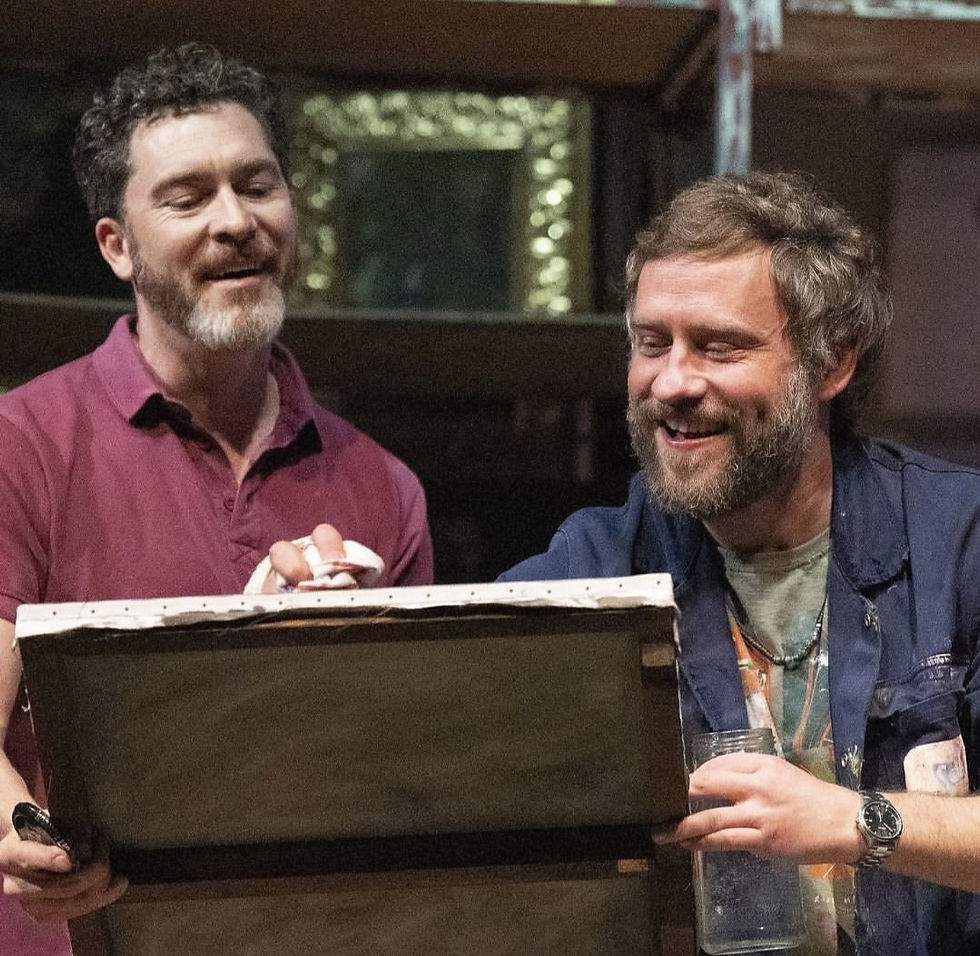
Peter Ash as Dave Hegarty gives a lively performance, injecting a much-needed dose of energy into the proceedings. His character feels well-rounded, walking the line between charming rogue and something more sinister, and he brings real charisma to the stage whenever he appears. Fiona Wade and Ben Cutler, playing Freya and Harry Kipling, give earnest performances, but their characters come off a bit flat. This seems to be more a fault of the writing than the acting—they aren’t given quite enough emotional range or development to feel fully believable, which makes it hard for the audience to invest in them. Their interactions feel a bit surface-level, which is a shame given the central role their relationship plays in the narrative.
Nicholas Maude as Stuart Piper has a certain presence, he adds tension and a sense of unease to the scenes he’s in, which is definitely effective, but there's a lack of believability when it comes to his supposed obsession with art—the passion doesn’t fully translate. Again, this may be a scripting issue, but it leaves the character feeling a touch two-dimensional. The clear standout in the cast is Jodie Steele as Roberta Kilgore. She delivers a performance that’s equal parts hilarious and menacing, managing to balance dry wit with a genuinely threatening undercurrent. Steele’s timing is impeccable, and her ability to shift gears between comedy and darkness adds real depth to the character. Roberta feels fully fleshed out—complicated, clever, and just unpredictable enough to keep the audience on edge. It's a role that could easily become cartoonish, but Steele plays it with enough nuance and intelligence to keep it grounded.
George Rainsford returns as Roy Grace, and he plays the detective with his signature calm, composed likability. He’s very watchable, and you believe in his character’s intelligence and moral compass. However, the lack of backstory or personal stakes in this particular script leaves Grace feeling a little one-note. Rainsford does his best with the material, but you’re left wanting to understand more about what drives him beneath the surface.
Picture You Dead is a stylishly directed and visually clever production with strong technical contributions and a few standout performances—especially Jodie Steele’s sharp and layered portrayal of Roberta Kilgore. While the script has its moments, it doesn’t always deliver the tension or complexity it promises, and some characters feel underwritten. Still, this is an entertaining and well-executed show with enough wit, suspense, and design brilliance to make for an enjoyable night at the theatre. It might not be a full-throttle thriller, but it's definitely worth a watch—especially if you appreciate slick staging and smart theatrical design.


Comments